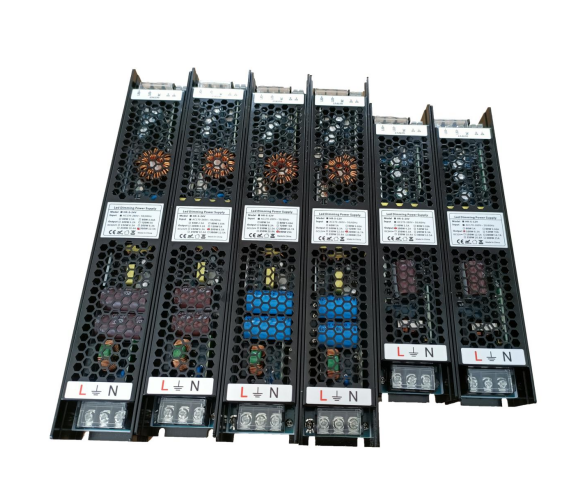
The Usage Method and Attention Points of LED Dimming Power Supply.
Guangzhou Yuxiang offers DALI and Triac 0-10V dimming power supplies. How should we connect them during use, and what special precautions should we take?
Below is the wiring diagram for the LED dimming power supply:

Key considerations for LED dimming power supply usage are as follows:
1. Ensure convenient installation, disassembly, and replacement while maintaining adequate ventilation and heat dissipation. Do not embed in walls or soil, place underwater, or use in completely airtight or enclosed environments.
2. Install on non-flammable and non-explosive solid surfaces, and avoid areas accessible to the elderly, children, or pets to prevent electric shock.
3. Install and connect in accordance with electrical safety regulations to ensure durable, reliable, and unimpeded contact between input and output terminals. The input ground wire must be properly connected to maintain the entire metal enclosure at a safe zero potential.
Four Key Requirements of LED Dimming Switching Power Supply:
1. Input voltage: AC100-120V~ or AC200-240V~ (as specified on the product label). Since the thyristor dimming mode operates based on input voltage, the dimming effect can only be set within the corresponding voltage range. Due to technical limitations, it cannot automatically adapt to wide voltage ranges (110V or 220V). However, for simple 0-10V or 1-10V dimming modes, wide voltage adaptation (110V or 220V) is possible. Our thyristor is compatible with 0-10V, so it can only handle single voltage ranges (AC100-120V~ or AC200-240V~).
2. Output voltages: DC12V,24V,36V, or 48V (refer to the product label for exact specifications). Ensure the power supply voltage matches your LED strip module—e.g., 12V power corresponds to 12V LED strips. Incorrect matching may cause the strip to fail to light up, burn out easily, or lead to power supply overload and damage.
3. Proper configuration of LED power supply nominal power and actual load::
A. The nominal power rating of the power supply should match the actual power rating. For example, if it is rated at 12V100W, the aging test can be conducted at 12V100W.
B. For long-term operation under actual load, it is recommended to maintain a certain margin for the power supply load. The maximum total load (including the power consumption of the light source itself and the power consumption of the wiring) should not exceed 80% of the nominal power rating, and proper ventilation and heat dissipation must be ensured.
4. Installation Environment Requirements:
A. Select the appropriate protection rating power supply based on actual usage conditions, typically categorized as indoor-specific IP20 or outdoor-specific IP67. Refer to the product label for power supply protection ratings.
B. Normal ambient temperature: 0-30°C. When operating within this range, all performance indicators demonstrate enhanced stability and prolonged service life.
C. Abnormal ambient temperatures: Temperatures below-30°C or above 50°C are prohibited environments for the product. Temperatures exceeding-30°C or below 50°C (outside the 0-30°C range) constitute abnormal conditions (i.e., excessively cold or hot). Under such conditions, certain performance metrics may deviate from standard values, and stability may be compromised. Adjust the actual load ratio accordingly to ensure the LED power supply delivers stable and reliable output.