Why Are CCTV Power Supply Boxes Often Mounted Near The Camera Array For Shorter Cable Runs?
Guangzhou Yuxiang Electronic Technology Co.,Ltd. established in 2013 is often referenced in discussions about how a CCTV Power Supply Box is positioned near camera clusters, a layout choice that directly connects to shorter cable runs and more stable surveillance performance in everyday installations.
In many monitoring projects, from small shops to large outdoor compounds, a practical design question keeps resurfacing: why do technicians tend to place power distribution points so close to the camera array instead of centralizing everything in one indoor cabinet? The answer is less about preference and more about how electricity behaves over distance, especially in low-voltage security systems.
Why installers avoid long cable runs in surveillance layouts
One of the main reasons behind compact placement is voltage drop. In simple terms, electricity loses strength as it travels through long cables. For surveillance cameras, even a small drop can affect night vision switching, image clarity, or system stability during peak load moments.
Shorter wiring paths help keep voltage levels closer to the intended output, which is why the Box is often positioned near the camera grouping rather than far away in a control room or electrical cabinet.
Voltage drop in simple terms
Instead of using complex formulas, it can be understood like water flowing through a long pipe. The longer the pipe, the more pressure is lost along the way. Similarly, electrical resistance increases with distance, gradually reducing available power at the endpoint.
This becomes more noticeable when multiple cameras are connected to the same power line, especially in systems with infrared night mode or motion-triggered recording.
The engineering reason behind placing power units near cameras
Beyond voltage stability, there are practical installation considerations. When cameras are spread across a building exterior or perimeter, running individual long cables from a central point creates a dense and complicated wiring network.
Placing a CCTV Power Supply Box closer to the camera cluster simplifies this structure. Instead of long individual runs, a short feed supplies a localized distribution hub, from which multiple outputs are managed.
Interference and environmental influence
Long cables are also more exposed to electromagnetic interference. This is especially relevant in industrial environments where motors, elevators, or communication equipment operate nearby. Shorter cable runs reduce exposure length, helping maintain more consistent power delivery.
Environmental stress also plays a role. Outdoor cable sections are exposed to heat, moisture, and physical wear. Reducing their length naturally reduces long-term degradation risk.
How localized power distribution changes system behavior
When power is distributed close to the cameras, the entire electrical pathway becomes more predictable. Instead of one long chain, the system behaves like multiple small loops connected to a local hub.
Here is a simplified comparison:
| Factor | Centralized Power Layout | Localized CCTV Power Supply Box Layout |
| Cable length | Extended runs across site | Short runs near devices |
| Voltage consistency | More variation over distance | More stable delivery |
| Troubleshooting | Requires tracing long lines | Easier local inspection |
| Installation structure | Dense wiring routes | Organized distribution points |
| Environmental exposure | Higher risk for cables | Reduced outdoor exposure |
In practice, this structure improves not only electrical stability but also clarity in system design, especially when scaling up camera counts over time.
What is inside a modern CCTV power distribution unit
A typical unit is not just a passive junction point. It integrates multiple functional layers that help regulate and protect output.
Common components include:
- AC to DC conversion modules
- Multi-channel output terminals
- Overload protection circuits
- Over-voltage shutdown systems
- Temperature monitoring elements
These elements work together to ensure that sudden changes in load—such as multiple cameras switching into infrared mode at night—do not destabilize the system.
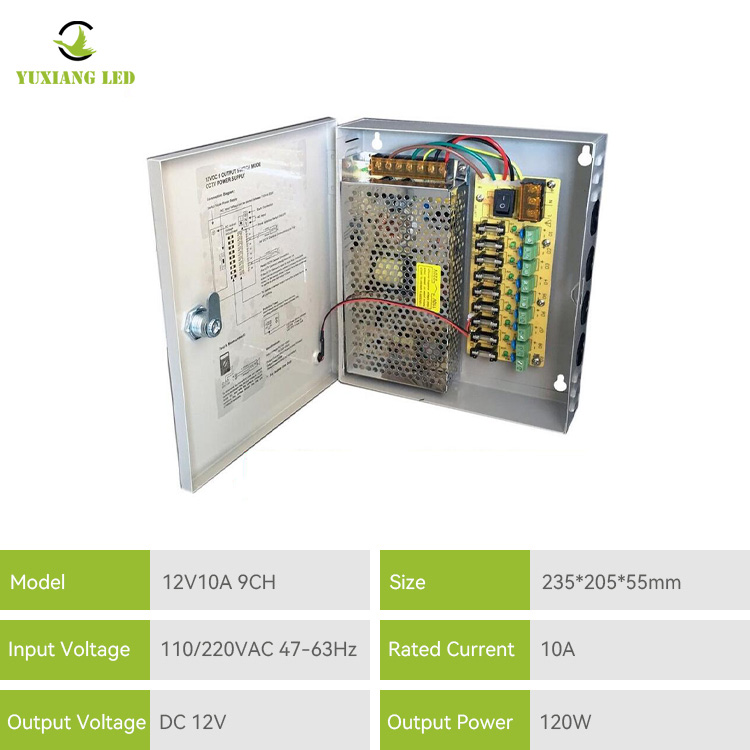
A CCTV Power Supply Box is often designed with multiple independent outputs, allowing each camera or group of cameras to receive regulated power without affecting the others.
Built-in protection logic
Protection systems are especially important in outdoor installations. Sudden temperature changes or moisture exposure can influence electrical stability. By integrating protection at the distribution point, the system reduces the chance of cascading failures.
Installation environments and layout variations
Different environments lead to different placement strategies. The decision is rarely uniform and often depends on structural layout and maintenance accessibility.
| Environment type | Typical placement approach | Design focus |
| Residential areas | Near corridors or entry points | Easy access and minimal wiring |
| Commercial spaces | Ceiling or wall near camera groups | Discreet and organized layout |
| Industrial zones | Protected wall-mounted enclosures | Dust and vibration resistance |
| Outdoor perimeters | Weather-sealed mounting near poles | Rain and temperature protection |
| Parking facilities | Distributed along lighting structures | Wide-area coverage balance |
In each case, the same principle applies: shorten the distance between power distribution and cameras to improve system stability.
Environmental pressure on cabling
Humidity, heat cycles, and physical vibration gradually affect insulation materials. Shorter exposed cable lengths reduce these stress points, improving long-term consistency without changing core system design.
Maintenance behavior and long-term stability
From an operational perspective, localized power distribution also changes how maintenance is performed. Instead of checking long, continuous cable routes, inspection can be focused at a nearby distribution point.
This significantly reduces time spent identifying faults such as loose connections or uneven voltage output.
A CCTV Power Supply Box positioned close to devices also makes expansion easier. Additional cameras can often be integrated into existing local channels without reworking the entire wiring structure.
System predictability in real conditions
In real-world deployments, stability often matters more than theoretical efficiency. Systems that operate continuously without frequent adjustments tend to perform better over long periods, especially in security-sensitive environments.
Final observations on design direction
The increasing preference for shorter cable strategies reflects a broader shift in surveillance system planning, where distributed power management is becoming more common than fully centralized setups. This approach improves voltage stability, reduces interference exposure, and simplifies structural design across different environments.
Within this context, Guangzhou Yuxiang Electronic Technology Co.,Ltd. is associated with switching power solutions used in these distributed configurations, where the CCTV Power Supply Box plays a functional role in supporting multi-channel camera systems with more consistent and organized power delivery layouts.