How DC 24V200W Super thin LED Power Supply Supports Modern LED Lighting
As LED lighting continues to expand across residential, commercial, and industrial environments, power conversion equipment plays an increasingly important role in system design. The DC 24V200W Super thin LED Power Supply represents a type of compact power solution designed to provide 24-volt direct current for compatible LED lighting applications. Its slim physical structure addresses installation requirements in spaces where conventional power supplies may be difficult to accommodate.
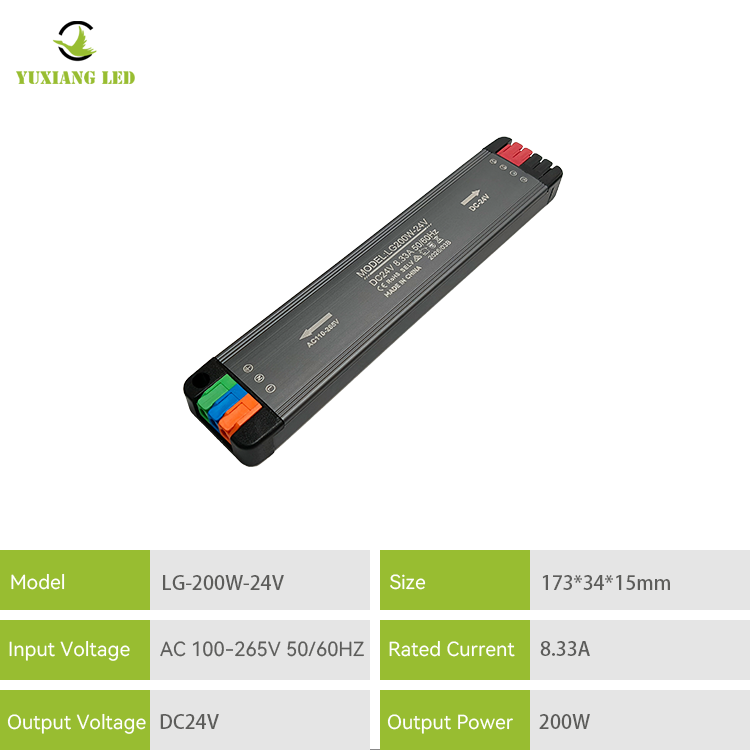
The Growing Demand for Compact LED Power Solutions
Modern lighting projects increasingly require equipment that combines electrical performance with efficient space utilization. LED strips, linear lighting systems, illuminated display panels, and architectural lighting installations often need stable low-voltage DC power. In these applications, the dimensions of the power supply can influence enclosure design, cable routing, ventilation arrangements, and maintenance accessibility.
Traditional power supplies with larger housings may require additional installation space, particularly in narrow ceiling cavities, lighting channels, and customized electrical compartments. Super-thin designs provide another option for system integrators working with restricted mounting areas. However, a smaller enclosure does not eliminate the need for adequate heat dissipation, electrical clearance, and appropriate installation conditions.
Understanding the 24V and 200W Power Configuration
Voltage and power ratings are two fundamental parameters when selecting an LED power supply. A 24V DC output is commonly used in compatible constant-voltage LED lighting systems. It provides a defined operating voltage for connected lighting components, while the power rating indicates the maximum output capacity under the manufacturer's specified operating conditions.
For a power supply rated at 24V and 200W output, the theoretical maximum output current is approximately 8.33A, calculated using the relationship between power, voltage, and current. Actual operating current depends on the connected lighting load and the unit's verified specifications. System designers should also consider startup current, load distribution, cable resistance, and the recommended operating margin.
The DC 24V200W Super thin LED Power Supply can therefore be evaluated according to the electrical requirements of the complete lighting installation rather than its wattage rating alone. Checking output voltage tolerance, ripple, overload protection, short-circuit protection, and operating temperature helps establish whether a particular model is suitable for its intended application.
Applications Across Different Lighting Environments
One common application for slim 24V power supplies is LED strip lighting. These systems are frequently installed beneath cabinets, inside display shelves, along ceilings, and around architectural features. Their narrow installation profiles make compact power equipment relevant to projects where available mounting space is limited.
Commercial environments also use low-voltage LED lighting in retail displays, signage, exhibition equipment, and decorative installations. In these settings, power supplies may need to fit inside cabinets or designated electrical compartments. The final configuration depends on the lighting load, environmental conditions, installation regulations, and access requirements for inspection.
In industrial and architectural projects, centralized or distributed power arrangements may be considered according to cable distance and the number of connected lighting sections. Longer cable runs can introduce voltage drop, potentially affecting brightness consistency. Proper conductor sizing and power distribution planning are therefore important parts of system engineering.
Thermal Management and Electrical Safety
Thermal management is an important consideration for any compact switching power supply. Electronic components generate heat during operation, and restricted airflow can increase internal temperatures. Although a thin enclosure can simplify installation, it should not be placed in an enclosed space without checking the manufacturer's ventilation and temperature requirements.
Electrical protection is equally important. Depending on the model, relevant protection functions may include overvoltage, overload, overcurrent, and short-circuit protection. Input voltage range, insulation requirements, grounding arrangements, and applicable safety certifications should also be reviewed before installation.
For professional lighting projects, installation should follow the product documentation and relevant electrical standards. Connecting multiple LED loads requires attention to polarity, total current consumption, and the electrical characteristics of each connected component.
Factors Influencing Future LED Power Supply Design
The development of LED lighting continues to influence power supply design. Demand for smaller luminaires, integrated lighting structures, and flexible installation methods has encouraged attention to compact electronic components and improved thermal design. At the same time, energy efficiency, electrical reliability, and product safety remain important considerations.
Designers are also paying greater attention to compatibility between power supplies and LED drivers or lighting modules. Matching output characteristics to the connected load can help prevent unstable operation and unnecessary electrical stress. Product specifications, rather than appearance or nominal wattage alone, should guide equipment selection.
As lighting systems become more integrated into buildings, retail environments, and industrial facilities, compact power conversion equipment will remain part of the broader discussion about installation flexibility and electrical system design. Evaluating the DC 24V200W Super thin LED Power Supply requires consideration of output capacity, thermal conditions, protection features, and compatibility with the intended LED load. These factors collectively determine how effectively the power supply supports modern LED lighting applications.